
Ghana TVET Service and DTI Sign Strategic Partnership to Strengthen TVET Delivery, Employability and Workforce Competitiveness
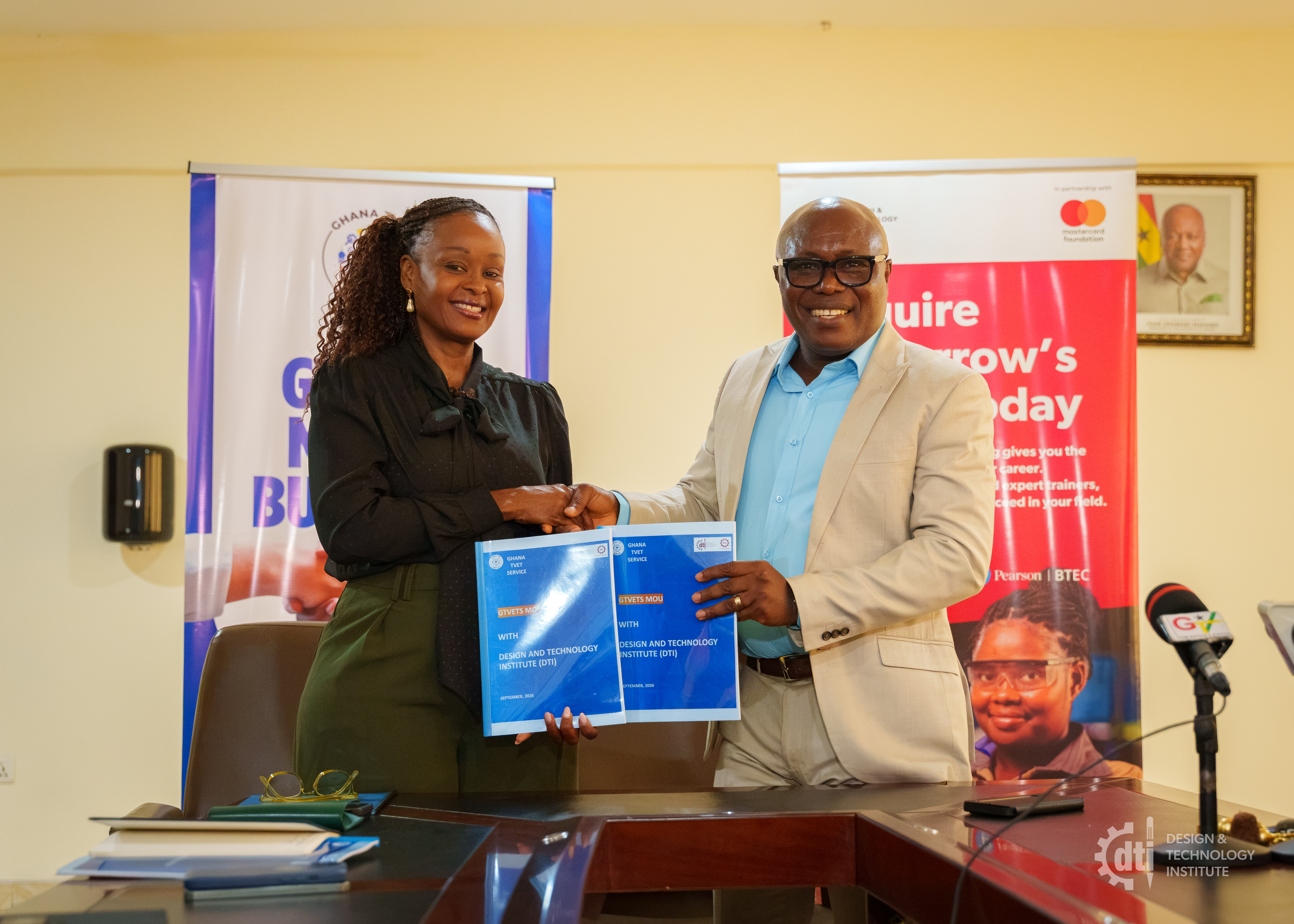
Accra, 15 September 2026 - The Ghana TVET Service (GTVETS) and the Design & Technology Institute (DTI) have signed a Memorandum of Understanding (MoU) establishing a strategic Public–Private Partnership to strengthen Technical and Vocational Education and Training (TVET), deepen industry participation in skills development, and improve employment and entrepreneurship outcomes for young people in Ghana.
The partnership brings together the national reach of Ghana TVET Service and DTI’s expertise in industry-led skills development, institutional strengthening and workforce preparation to build a more responsive, quality-driven and industry-aligned TVET ecosystem supporting Ghana’s industrialisation and human capital development agenda.
The agreement provides a framework for collaboration in institutional strengthening, trainer and leadership development, Workplace Experience Learning (WEL), apprenticeship and dual TVET systems, industry engagement, digital transformation, quality assurance, research, monitoring and evaluation, and transition-to-work support.
Engr. Dr. Eric Kofi Davis Adzroe, Director-General of the Ghana TVET Service, described the partnership as a purposeful collaboration to support Government’s efforts to equip young people with relevant and employable skills.
He said Ghana TVET Service, established under Act 1049 to implement pre-tertiary TVET policies and programmes, currently oversees about 261 TVET institutions across the country.
Prof. Adzroe observed that many graduates remained unemployed years after completing their education because they lacked practical skills demanded by industry.
“I have seen graduates four, five, six and even nine years after university struggling to find employment,” he said, stressing the need to complement academic qualifications with marketable skills that could enable individuals to create opportunities for themselves.
He said the partnership would initially focus on strengthening the capacity of teachers and facilitators to remain abreast of changing technologies and industry practices.
“The world is changing rapidly in technology, ideas and every aspect of human existence. We need to work with institutions such as DTI that are at the forefront of advanced skills development,” he said.
Prof. Adzroe reiterated the central role of skills development in Ghana’s economic transformation and job creation agenda.
“The only way we can transform this country is through TVET. TVET is skills,” he said.
Drawing on observations from a recent visit to Germany, he noted that high-quality craftsmanship and attention to detail were major contributors to industrial competitiveness and productivity, adding that Ghana must place similar emphasis on excellence in skills training.
He also advocated a continental approach to skills development, noting that Africans would continue to move across borders in search of opportunities and should therefore possess recognised and transferable skills.
“People will move, but they must move with value,” he stated.
Ms. Constance Swaniker, Founder and President of DTI, said the partnership reflected a shared commitment to strengthening the institutions and systems required to support Ghana’s industrialisation, productivity and employment ambitions.
She identified gaps in trainer competencies, workplace exposure, industry linkages, skills data systems and utilisation of training equipment as areas requiring sustained attention.
“These are not failures of intention but realities of a system being asked to do more, move faster and serve more young people than ever before,” she said.
Ms. Swaniker said DTI, a Pan-African not-for-profit TVET Centre of Excellence, was established to demonstrate that African institutions could deliver training to globally competitive standards.
Through its partnership with the Mastercard Foundation, DTI has trained more than 40,000 young people and master craftsmen since 2020, including about 15,000 persons from the informal sector. This year, 4,760 master craftsmen and small business owners graduated from DTI’s Precision Quality programmes in Accra, Kumasi, Takoradi and Tamale.
She said DTI’s programmes are benchmarked against international standards and accredited by organisations including the American Welding Society, the National Occupational Competency Testing Institute (NOCTI) of the United States, and Pearson.
“When a young person completes training at DTI, the certificate in their hands is recognised in Houston, Hamburg or Johannesburg, not only in Accra,” she said.
Ms. Swaniker also highlighted DTI’s Precision Quality™ methodology, which combines technical competence with workplace values such as accountability, safety consciousness, teamwork, professionalism and continuous improvement.
“Technical ability may open the door to the workshop, but a Precision Quality mindset is what allows a young person to remain there, excel and progress,” she noted.
Under the partnership, Ghana TVET Service and DTI will undertake institutional assessments and use the findings to strengthen training delivery, trainer and leadership capacity, institutional systems and the effective utilisation of infrastructure and equipment.
A major focus will be on bringing industry closer to TVET through stronger Workplace Experience Learning, Industry Liaison functions, apprenticeship and dual TVET models, employer partnerships and industry participation in training. The collaboration will also strengthen pathways from training into wage employment, self-employment and entrepreneurship, supported by improved graduate and employment tracking.
Digital transformation and data will form another important pillar, including opportunities to strengthen digital learning and management systems, skills data, monitoring and evidence-based decision-making. The partnership will also support stronger quality assurance, internationally benchmarked training and certification pathways, research and labour-market responsiveness.
Ms. Swaniker stressed that the collaboration was intended to strengthen the broader TVET ecosystem rather than create isolated centres of excellence.
“We are not seeking to create islands of excellence. We are working to strengthen the system as a whole,” she said.
The partnership will therefore seek to develop, demonstrate, institutionalise and scale what works, while collaborating with Government, industry, academia and development partners and aligning interventions with Ghana’s broader Human Capital Development agenda.
The MoU also creates a platform for the two institutions to jointly develop programmes and mobilise technical and financial resources to support sustainable TVET transformation.
Both parties expressed optimism that the partnership would contribute to a TVET system that is industry-responsive, technology-enabled, quality-driven and focused on outcomes—equipping Ghanaian youth with the skills, mindset and workplace experience required to succeed in Ghana, across Africa and in the global workforce.
About the Design & Technology Institute (DTI)
The Design & Technology Institute (DTI) is a Pan-African not-for-profit TVET Centre of Excellence focused on industry-aligned skills development, workforce preparation, entrepreneurship, Workplace Experience Learning and systems strengthening. DTI works with Government, industry, academia and development partners to strengthen Ghana’s human capital ecosystem and is the developer of the proprietary Precision Quality™ (PQ) methodology.
About the Mastercard Foundation
The Mastercard Foundation works with partners to enable young people in Africa and Indigenous communities in Canada to access dignified and fulfilling work through education, skills development and financial inclusion.
About Young Africa Works
Young Africa Works is the Mastercard Foundation’s flagship initiative focused on enabling 30 million young Africans, especially young women, to secure dignified and fulfilling employment by 2030.
Media Enquiries
Design & Technology Institute (DTI)
Mohit Sharma – Project Coordinator
Ernest Frempong – Executive Assistant, Office of the President, DTI
Email: info@dtiafrica.com
Website: www.dtiafrica.com