
DTI Jobs & Opportunities Fair Brings Academia, Industry and Young People Together to Navigate Skills, Careers and the Future of Work
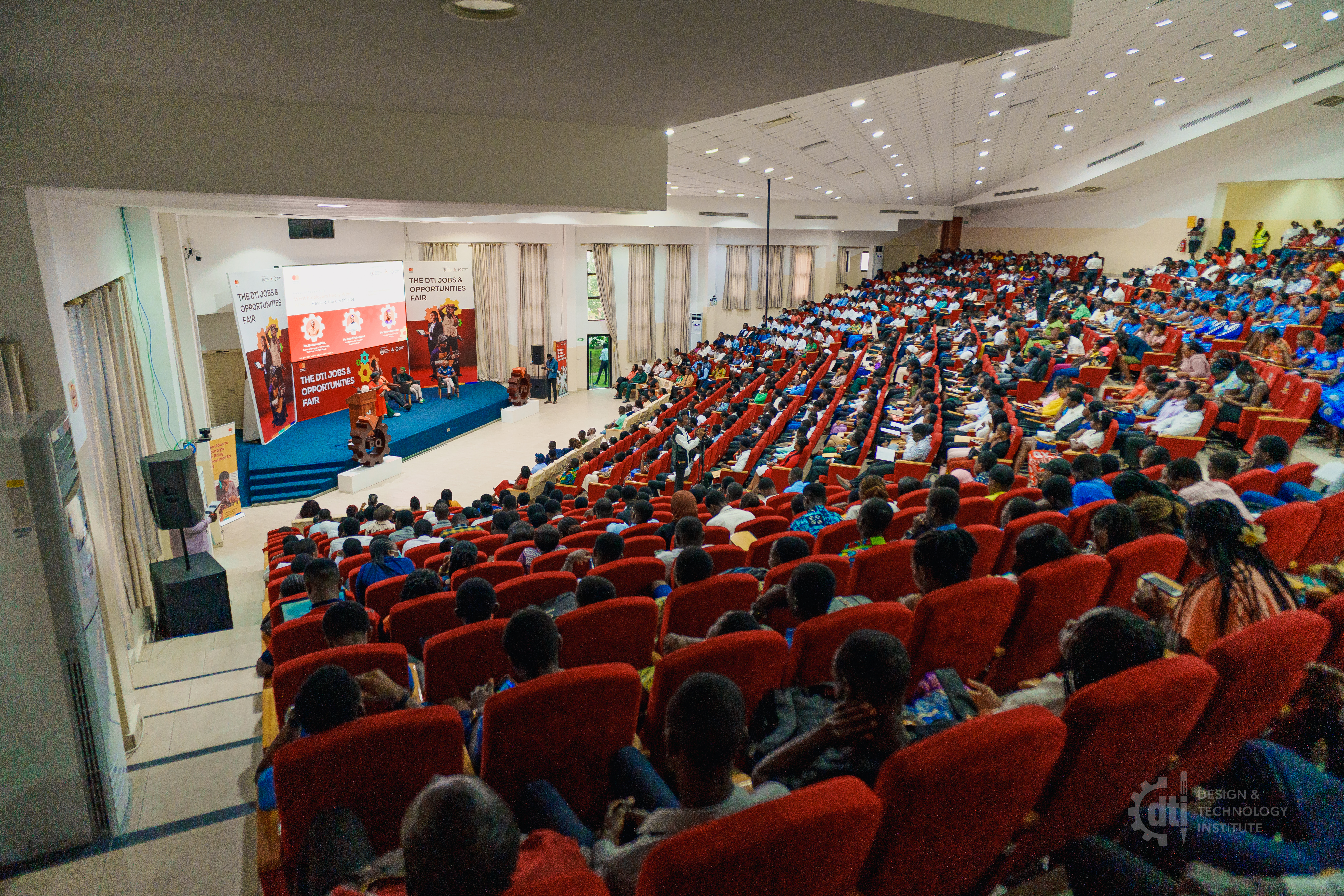
Held under the theme, "Navigating Skills, Careers and the Future of Work: Preparing Young People to Thrive in an AI-Enabled World," the one-day event, organised by the Design and Technology Institute (DTI) in partnership with its lead industry partner, Accents & Art, brought together academia, industry, employers, entrepreneurs, policymakers, development partners and hundreds of young people to explore how artificial intelligence, emerging technologies and changing workforce demands are reshaping careers and creating new opportunities.
DTI Founder & President Calls for AI-Ready Skills and Stronger Industry-Education Partnerships
Delivering the opening address, Founder and President of the Design and Technology Institute (DTI), Ms. Constance Swaniker, challenged young people to embrace artificial intelligence (AI), strengthen their technical competencies, and cultivate entrepreneurial mindsets to remain competitive in the rapidly evolving world of work.
She noted that while AI and automation are transforming industries globally, the greatest risk for Africa is not the loss of jobs to machines, but the inability of young people to acquire the skills needed to seize emerging opportunities. She described the 2026 DTI Jobs & Opportunities Fair as a platform designed to connect young people directly with employment, entrepreneurship and career opportunities by bringing together employers, educators, innovators, investors and development partners.
"It is not a talk shop. It is not a parade of speeches to be applauded and forgotten. It is a working marketplace where employers meet talent, where skills meet demand, and where a conversation at a booth this morning can become a contract, an apprenticeship or a business by the close of day," she said.
Building on the success of the 2025 Fair, which attracted more than 50 companies and resulted in interviews, mentorship opportunities and business ventures for many young people, Ms. Swaniker said this year's edition focused on helping participants understand how AI is reshaping jobs, skills and career pathways.
Citing World Economic Forum projections, she noted that while automation and AI could displace approximately 85 million jobs globally by 2030, they are also expected to create 97 million new roles, reinforcing the urgent need for continuous learning, upskilling and reskilling.
"The reality of AI is not that jobs will simply disappear. It is that the nature of work is changing, and opportunities will increasingly belong to those who are prepared, while leaving behind those who are not," she stated.
Highlighting the urgency of the challenge, Ms. Swaniker pointed to persistent youth unemployment and underemployment in Ghana and across Africa. According to the Ghana Statistical Service, youth unemployment among persons aged 15–24 averaged 32.5 per cent in the previous year, with the situation particularly acute in Greater Accra. She further noted that more than 1.3 million young Ghanaians are currently not in employment, education or training (NEET), while 10–12 million young Africans enter the labour market each year to compete for only about three million formal jobs.
She said these figures underscore the widening gap between education and labour market needs.
"This is the gap DTI was built to close. We do not train young people for the economy we wish existed. We train them for the economy that exists today and for the one that is emerging," she said.
Ms. Swaniker noted that since its establishment in 2016, DTI's industry-driven training programmes have contributed to more than 41,000 employment and entrepreneurship opportunities across Ghana. She added that over half of the Institute's learners are young women and that its internationally accredited programmes equip graduates with skills recognised both locally and internationally.
"Our learners do not merely graduate; they move directly into workplaces because industry has shaped their training from day one," she said.
Calling for stronger collaboration between academia and industry, she emphasised that preparing young people for the future of work is a shared responsibility.
"When industry partners with education, young people gain confidence, businesses gain skilled talent, our economy gains competitiveness, and our nation prospers," she added.
CTVET Reaffirms Commitment to Skills and TVET Transformation
Representing the Commission for Technical and Vocational Education and Training (CTVET), Deputy Director-General, Mr. Anthony Kwame Seyram Zu, reaffirmed the Commission's commitment to championing skills development, artificial intelligence and innovation as critical enablers of Ghana's TVET transformation. He noted that CTVET will continue to strengthen policies, systems and partnerships that support institutions in equipping young people with the competencies required for the future of work.
Mr. Zu commended DTI for raising the bar in technical and vocational education and workforce development, describing the Institute as a benchmark for industry-led, demand-driven skills training. He noted that DTI's internationally accredited programmes and globally recognised certifications are preparing young people not only for employment opportunities in Ghana, but also for competitive careers in regional and international labour markets.
Emphasising the importance of strong public-private partnerships, Mr. Zu underscored the need for closer collaboration between government, industry and training institutions to build a resilient, responsive and globally competitive TVET ecosystem. He assured DTI of CTVET's continued support in advancing national skills development and strengthening Ghana's workforce competitiveness.
Delivering the keynote address, Dr. David King Boison, Chief Executive Officer of the Knowledge Web Centre and Lead Consultant for the AI Africa Project, challenged young people to embrace artificial intelligence as a powerful enabler of innovation, productivity and career growth rather than a threat to employment.
"Artificial intelligence will not take your job. But a person who knows how to use it might," he said.
Dr. Boison emphasised that future competitiveness will depend on the ability of workers to combine strong technical expertise with AI literacy and digital skills.
"The machine is not your competitor. The person beside you who has learned to work with the machine is your competitor—and that person can be you," he told participants.
He noted that the Fifth Industrial Revolution is placing humans back at the centre of technological advancement, creating new opportunities for skilled professionals to work alongside intelligent systems rather than be replaced by them.
Addressing DTI trainees and graduates, he explained that technical professions such as welding, fabrication, manufacturing and design would become even more valuable when enhanced by AI and other emerging digital technologies.
"The welder who understands AI will out-earn the welder who does not. The fabricator who can use technology to simulate designs, improve precision and increase efficiency will have a competitive advantage," he said.
Drawing on experiences from the AI Africa Project, Dr. Boison showcased practical applications of AI across agriculture, healthcare and local language technologies, stressing that innovation must be harnessed to solve Africa's most pressing challenges.
He encouraged young people to master their chosen professions, develop the ability to effectively instruct and leverage AI systems, and adopt a problem-solving mindset capable of transforming local challenges into entrepreneurial and career opportunities.
"Do not wait for a job. Look at the problems around you and find ways to solve them," he urged.
Innovation for Community Impact
The Fair also recognised young innovators through the Accra Floods Hackathon, which challenged participants to develop technology-driven solutions to improve flood preparedness, disaster response and urban resilience in the capital.
Out of 88 applicants, only five finalists were selected, with each receiving USD 600 in seed funding to further develop their solutions. The winners were Nana Ama Nhyira Agyapong with SafeCity GH: AI-Powered Crowdsourced Risk Mapping; Carolyn Ngmen-Nomo Kuubetersuur with Smart Flood Drain Filter; Ativor Godsway Kwabla with FloodGuard: Report Hazards, Get Warned, Get Help; Ruth Asiedua Frimpong with Floodbuddy; and Berko Enoch Bill with AcquaAlert Accra.
The projects addressed challenges ranging from flood prevention and risk mapping to hazard reporting and emergency response, demonstrating how technology and innovation can be harnessed to solve real community problems.
One of the winning innovators, Nana Ama Nhyira Agyapong, a Level 300 Business Administration student at the University of Professional Studies, Accra (UPSA), developed an AI-powered platform that uses crowdsourced data to identify flood-prone areas and strengthen disaster preparedness.
She explained that the solution was inspired by the devastating impact of recurrent flooding on urban communities and reflected her desire to use technology to improve public safety and resilience.
Young Entrepreneurs Recognised for Innovation and Social Impact
The Fair concluded with the DTI Entrepreneurship Challenge Awards, celebrating young entrepreneurs whose businesses demonstrated innovation, commercial viability and the potential to create meaningful social impact.
Presenting the awards, Ms. Constance Swaniker described the finalists as "Africa's future changemakers," commending their ability to identify pressing societal challenges and transform them into practical business solutions.
"Every generation is remembered for something. Some generations inherit prosperity, others inherit crisis. But the generations that change history are those that choose to solve the problems before them. They are the changemakers," she said.
She emphasised that entrepreneurship is ultimately about creating value and solving real problems.
"It is not simply about building businesses; it is about building solutions. It is not merely about creating wealth; it is about creating value," she added.
Five businesses emerged as overall winners of the DTI Entrepreneurship Challenge and each received USD 10,000 in seed funding to support the growth and expansion of their enterprises. The winners were El-Roi Bakery, led by Cecilia Teni Akuka of Accra; Sue-Ssors Imagez (Waste to Wow), founded by Susana Abban Gatogo of Accra; Scarlet, led by Nana Ama Dankwaa Nyantakyi of Accra; Mafon's Loyalty Enterprise, founded by Afondek Millicent of Tamale; and Kporfor Farms, owned by Johnson Kporfor of Ho.
Entries were evaluated by an independent panel of judges based on innovation, business viability, growth potential and social impact.
Speaking after receiving her award, Nana Ama Dankwaa Nyantakyi, a 23-year-old graduate of the University of Ghana, credited the Precision Quality Internship (PQI) programme with helping shape her entrepreneurial journey by providing practical industry exposure and hands-on experience.
"The programme exposed me to practical skills and experiences that have strengthened my entrepreneurial journey," she said.
For Cecilia Teni Akuka, Chief Executive Officer of El-Roi Bakery, the award marked an important milestone in growing a business established to meet the increasing demand for affordable baked products, particularly shortbread, among schoolchildren and roadside retailers. She explained that she discovered the PQI programme through a WhatsApp link while searching for business support opportunities.
"I wanted to grow my business but needed both skills and capital. The programme gave me the opportunity to improve and compete," she said.
Another recipient, Afondek Millicent, founder of Mafon's Loyalty Enterprise, described the award as a significant boost to her fashion business. A Bachelor of Technology student in Fashion at Tamale Technical University, she combines African cultural aesthetics with contemporary fashion design and embroidery, having built her enterprise from a small sewing business while pursuing her studies.
A Call to Continuously Learn, Adapt and Innovate
In his closing remarks, DTI Project Coordinator, Mr. Mohit Sharma, encouraged young people to prepare for a rapidly evolving labour market by developing adaptable, future-ready skills and embracing lifelong learning.
He noted that while academic qualifications remain important, they are no longer sufficient on their own to guarantee success in an economy increasingly shaped by technology, artificial intelligence and innovation.
"The future of work demands adaptability, creativity, problem-solving skills and continuous learning," he said.
Mr. Sharma urged participants to embrace artificial intelligence as a catalyst for innovation and productivity, leveraging technology not only to enhance their careers but also to create businesses, solve real-world challenges and generate employment for others.
Congratulating the winners of the Entrepreneurship Challenge and the Accra Floods Hackathon, he described the awards as an investment in the next generation of innovators and entrepreneurs whose ideas have the potential to create jobs, strengthen communities and contribute to Ghana's economic transformation.
"The future of work is already here. The question is not whether it will change, but whether we are ready to grow with it," he said.
The Fair brought together more than 50 organisations across manufacturing, banking, telecommunications, agribusiness, technology, media, engineering and education. Participating organisations included Absa Bank Ghana, Fidelity Bank Ghana, Telecel Ghana, ALX Ghana, Soronko Academy, AWS Industrial Solutions, Farmershaus Limited, Tech Oasis Limited, Accra Metropolitan University, alongside several DTI alumni-owned businesses.
Throughout the day, participants also engaged in practical workshops on artificial intelligence, prompt engineering, personal branding, financial readiness, entrepreneurship and career development, while connecting directly with employers, recruiters, training institutions and industry professionals through exhibitions, networking sessions and on-the-spot career opportunities.
As the event concluded, organisers reaffirmed the importance of sustained investment in technical and vocational education, industry partnerships, digital skills and innovation-driven entrepreneurship. The Fair demonstrated how market-relevant training, mentorship, industry exposure and access to employment and enterprise opportunities can empower young people to secure dignified work, build businesses and contribute to Ghana’s economic growth.
About the Mastercard Foundation
The Mastercard Foundation works with partners to enable young people in Africa and Indigenous communities in Canada to access dignified and fulfilling work. Its programmes advance education, skills development, and financial inclusion to promote inclusive and equitable growth.
About Young Africa Works
Young Africa Works is the Mastercard Foundation’s flagship initiative focused on enabling 30 million young Africans, especially young women, to secure dignified and fulfilling employment by 2030.
Media Contact
Design & Technology Institute (DTI)
Media Enquiries:
Mohit Sharma – Project Coordinator
Ernest Frempong – Executive Assistant, Office of the President, DTI